Thoughts on a Beginner's Large Format Film Camera
Long-winded response + TLDR version

How this post Started:
Dave from Stillness in Focus reached out and asked me “What’s a good 4x5 to start with?”. He mentioned a monorail camera. Of course, I had many thoughts. I’ll preface all of this by saying that I’m not a large format photography expert. I’m only sharing my experiences. My joke is that I’m like the piano teacher who is only 2 lessons ahead of their students. If you want to jump to the TLDR version, you can find it here:
Here’s the longer-winded version.
Here are my large format musings based on my experiences so far:
I think it’s similar to that sign at the old-school mechanic’s shop. “We offer 3 kinds of services. cheap, good, or fast. You can only pick two.”
Here are my $0.02 on this topic.
One of our photo friends has a monorail camera. It’s a beautiful machine that comes in a large, metal, military green case. They basically have all the movements, they’re sturdy, and they lock down well. Some of them have geared movements. Sometimes you see pictures of these cameras all twisted up like a pretzel to show all of the possible movements. The rail cameras can be a good value (although there are some pricey versions), but not necessarily as portable. They can be bigger and heavier if you want to try and stick them in a backpack. Here’s a link to some 4x5 monorail cameras.
Then you have the press cameras like the Graflex cameras. They are compact, sturdy, but don’t have as many movements. Only a little rise and tilt. There a few types of those as well. I’ve had both the Speed Graphic and the Crown Graphic. The Speed Graphic has a focal plane shutter. This is useful for lenses that don’t have an integrated leaf shutter, like the Kodak Aero Ektar or Petzval lenses. Only downside for me, was that it didn’t have a graflok back. So I couldn’t use 120 film backs or the Lomograflok. The Crown Graphic that I recently got from Seawood photo doesn’t have a focal plane shutter, but it does have Graflok back. I’m really happy with this camera so far. I don’t have to be as careful with it as I would with a pricier wooden view camera. There’s also the Horseman 45FA field camera. It’s technically not a press camera, but it is a metal folding 4x5 camera. It has a few more movements, a back that can be removed for portrait/landscape orientations, and it’s a good looking camera. It’s a little pricier and uses its own type of lens board. I would love one of these. Kyle McDougal uses this camera for his current projects. More info on the Horseman 45FA camera here: https://ewaldvorberg.de/homepage/en/horseman-45fa/
Then there’s the wooden view cameras. A light and value-priced camera like the plywood-based Intrepid 4x5 camera is also a good way to start. The camera is light, has quite a few movements, but it’s not as sturdy, and doesn’t lock down as well. It does have a graflok back, which s always a plus for me. Mine also suffered from a wobbly film back after I crammed in the shim for the Lomograflok Instax Wide film back. But that’s a story from another day. This is easily remedied by using the Brooklyn film camera lomograflok integrated shim/ground glass. You can also use any focal length from 75mm-300mm. Very versatile
The good thing is that most of these lenses can be used on almost any large format camera with the right style lens board. I started with the Intrepid 4x5 plywood camera and took some cool photos with it. Each version they make keeps getting better.
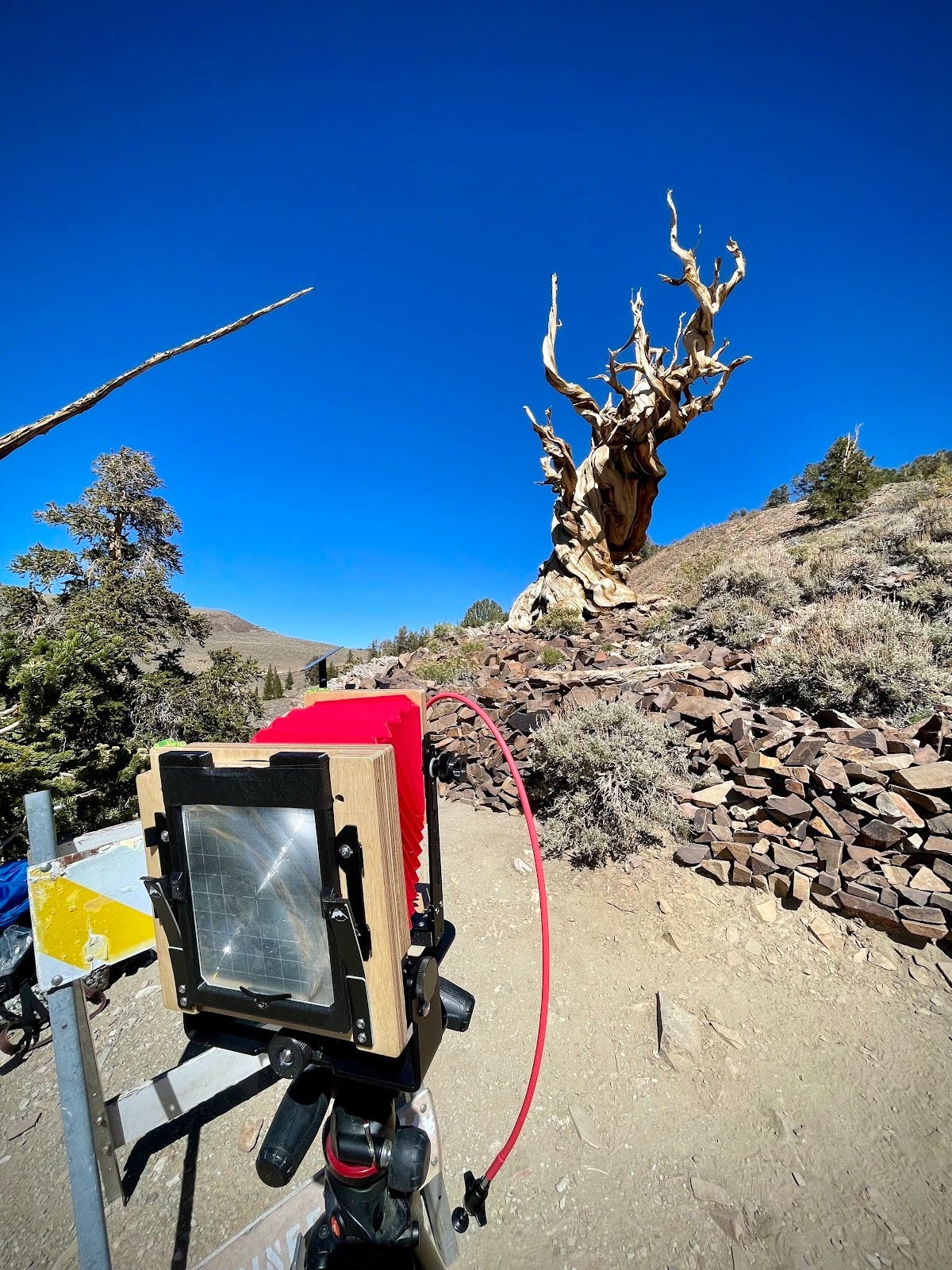
Here’s a BTS picture of my Intrepid 4x5 camera at the Bristlecone Pine Forest. I’m glad the camera was light as I huffed and puffed up that trail at high altitude. That camera + the 150mm lens (considered standard for 4x5) produced one of my all-time favorite photos!
Finally, here’s a link to Alex Burke’s e-book on large format photography. It’s only $24.99. Nick Carver has what I’m sure is a more comprehensive video course, but it’s $199. Alex is an accomplished photographer who produces beautiful landscape photos in the Colorado Rockies and prairies. Alex’s book is a good way to get an overview in the subject without breaking the bank. Alex also has a good blog that he keeps up. Some good info on how he got some of his photos. Alex started with an intrepid camera. He now uses a Chamonix 4x5 camera. I have one of these as well. It’s sturdier wood and higher quality. It’s definitely pricier, but nothing like some of the European-made models that are still made today (like Arca-Swiss and Gibellini).
Here’s the link to Alex’s e-book:
https://www.alexburkephoto.com/educational-ebooks/large-format-film-photography
The TLDR Version:
The short answer is I’d probably start with a Graflex Crown Graphic. It’s compact, It has some movements, it has a graflok back, and most of these cameras come with some sort of standard focal length lens with an integrated leaf shutter. Seawood photo often has them in stock and they answer questions